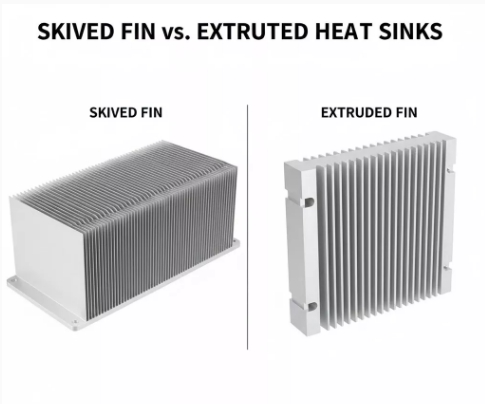


Skived Fin vs. Extruded Heat Sinks : Performance & Cost Comparison
페이지 정보
작성자 최고관리자 작성일 26-03-04 16:43본문
Extruded heat sinks dominate cost-sensitive, high-volume applications. Skived fin heat sinks dominate high-power-density designs where every watt and every millimeter counts. This guide breaks down the real differences so you can make the right choice.
1. What is an Extruded Heat Sink?
The Extrusion Process A heated aluminum billet (usually 6063 or 6061) is forced through a steel die to create a continuous profile with integrated fins. The profile is cut to length and finished (anodizing, machining, etc.).
Key Advantages
Very low per-unit cost at high volume
Fast, highly automated production
Monolithic construction = no fin-to-base thermal interface
Proven reliability for millions of units Major Limitations
Fin aspect ratio typically ≤ 10:1
Low fin density → limited surface area
Almost exclusively aluminum (copper extrusion is rare and expensive)
2. What is a Skived Fin Heat Sink?
The Skiving Process
A sharp blade precisely “shaves” thin fins from a solid block of aluminum or copper. Each fin is bent upright while remaining attached to the base — creating an ultra-dense, one-piece heat sink.
Key Advantages
Aspect ratios up to 50:1
Fin thickness as low as 0.2 mm and gaps < 0.5 mm
Works perfectly with pure copper (~390 W/m·K)
Zero thermal resistance between fins and base Drawbacks
Higher per-unit cost (especially at low volume)
Delicate fins require careful handling
Slower production than extrusion
3. Head-to-Head Comparison
| Feature | Extruded | Skived Fin |
|---|---|---|
| Thermal Performance | Good | Excellent (up to 3× better) |
| Fin Density | Low–Medium | Very High |
| Max Aspect Ratio | ≤ 10:1 | Up to 50:1 |
| Materials | Aluminum alloys | Aluminum + Copper |
| Cost (High Volume) | Very Low | Higher |
| Best For | Cost-driven, moderate power | High power density, space-limited |
Design Flexibility
Skiving is not limited by die geometry — engineers can optimize fin height, spacing, and shape for specific airflow conditions.
Cost Reality
Extruded wins at >10k–100k pieces. Skived becomes competitive at lower volumes and is often cheaper than moving to liquid cooling when extrusion can’t meet thermal targets.
Aluminum vs Copper
Copper skived fins (~390 W/m·K) outperform even the best aluminum extruded sinks (~200 W/m·K) by a wide margin when spreading resistance matters.
4. When to Choose Which Technology
Choose Extruded When:
Power dissipation < 100 W in ample space
High production volume (10k+ units)
Cost is the primary constraint
Standard profiles are acceptable
Choose Skived Fin When:
High power density (>150–200 W in small volume)
Limited height/footprint
Forced convection with strong airflow
Copper is desired or required
Performance is non-negotiable (servers, EVs, high-power LEDs, etc.)
Conclusion
Extruded heat sinks remain unbeatable for cost and volume. Skived fin heat sinks are the clear winner when maximum cooling performance in minimal space is required. Choose based on your thermal budget, physical constraints, and production volume — not on habit.
Frequently Asked Questions
Can skived fins be made from copper?
Yes — copper is one of the most popular materials for skived fins thanks to its ~390 W/m·K conductivity.
What is the maximum aspect ratio for extruded fins?
Typically 6:1 to 10:1. Anything higher becomes extremely difficult and expensive.
Is skiving more expensive than extrusion?
Per unit yes, especially at high volume. But skiving has lower or zero tooling cost and often eliminates the need for liquid cooling.
Which is better for natural convection?
Skived copper usually wins due to higher conductivity and larger effective surface area, even without a fan.